My name is David, and I’m the Chair of the Joint Nature Conservation Committee.
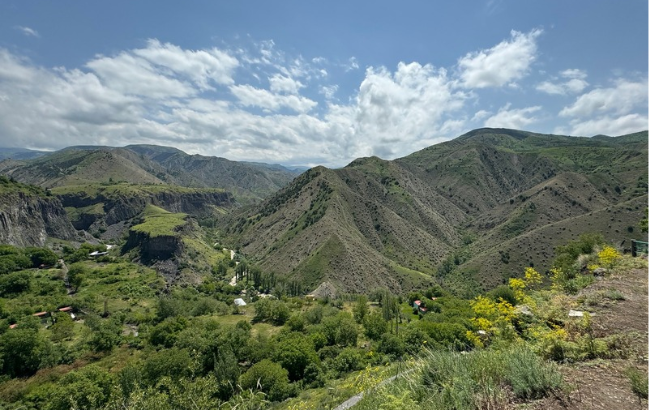
This post is a reflection on my time spent at the UN Biodiversity Conference (COP17) in Yerevan, Armenia.
A global plan - but progress needed
After two weeks of intense negotiations, the conference concluded with agreement on the Yerevan Pathway – a shared plan to accelerate global action to halt and reverse biodiversity loss by 2030.
This is an important achievement. Biodiversity underpins our food, water, health, economies and security. Its decline threatens livelihoods and prosperity, and increases vulnerability to extreme events.
But what encouraged me most was the determination of people from across the world to work together for nature, despite difficult geopolitical and economic circumstances.
Four years ago, in Montreal, governments adopted the landmark Kunming-Montreal Global Biodiversity Framework: 23 targets for 2030 and four longer-term goals to halt and reverse nature loss.
COP17 marked the halfway point to 2030. The first global report of collective progress showed unprecedented engagement by countries, but also that we are not on track to achieve the agreed targets.
The global report drew on national reports that have been provided by over 170 countries. The UK’s own report on progress was coordinated by JNCC, drawing on the UK Biodiversity Indicators.
The Yerevan Pathway, adopted alongside some 40 other decisions, acknowledges this gap. It calls for accelerated implementation, stronger action across government and society, improved monitoring and increased resources, particularly for developing countries.
Tackling the causes of nature loss
The Pathway recognises that we must tackle the underlying drivers of biodiversity loss.
Conservation and restoration remain essential, but cannot succeed while economic systems continue to drive nature's decline.
Behind pressures such as land-use change, overexploitation, pollution, climate change and invasive species lie patterns of production and consumption, economic incentives, governance and societal values.
Reforming harmful subsidies and incentives is especially important. Under Target 18, countries agreed to reduce harmful incentives by at least $500 billion annually by 2030, while increasing positive incentives.
Progress has been slow, and negotiations in Yerevan were contentious. Nevertheless, the final agreement encourages accelerated implementation of Target 18. This issue was given further impetus by the COP Presidency, who announced one of many complementary initiatives on this topic.
Action and determination across society
COPs are much more than intergovernmental negotiations.
Beyond the negotiations, Indigenous Peoples, local communities, women, young people, scientists, businesses and organisations demonstrated practical action and exchanged ideas.
I joined events run by youth networks, researchers and Indigenous organisations. I was struck by the passion of Indigenous Peoples and local communities defending their rights, territories and livelihoods, and by the commitment of young people. They are essential partners and leaders in nature recovery.
Discussions reinforced the importance of combining scientific evidence with Indigenous and local knowledge. For JNCC, providing robust evidence, monitoring progress and informing decisions are important contributions to this collective effort.
Mobilising finance and progress on the Cali Fund
Finance remained one of COP17's most difficult issues.
At various events throughout the conference, I saw growing recognition that nature recovery requires changes in how economies operate.
We must invest more in nature and stop financing its destruction.
Many developing countries face high debt, limited resources and declining aid, and we cannot yet show that the target of $20 billion annually in international biodiversity finance by 2025 has been achieved.
Nevertheless, there were positive developments. Countries made further pledges to various funds, and also agreed measures to improve access to finance and advance discussions on longer-term financial arrangements.
I was proud to see the UK playing a particularly constructive role, including the announcements of £20 million of new funding to protect coral reefs, marine wildlife and the coastal communities that depend on them, as well as its contributions to the Tropical Forests Forever Facility and the Global Environment Facility.
Another encouraging outcome concerned the Cali Fund, established at COP16 to share benefits from the use of digital sequence information on genetic resources.
Countries clarified arrangements for recognising companies' monetary contributions and agreed further work on the Fund's operation and distribution of benefits.
The Fund could generate substantial funding for biodiversity, including for Indigenous Peoples and local communities. Yet contributions remain tiny compared with its potential. The steps taken at COP17 could help turn an important innovation into a meaningful source of finance for nature.
We are making welcome progress, but overall funding for nature remains far below what is required.
Multilateralism prevails, but the real test begins at home
COP17 was far from perfect. Negotiations were sometimes frustrating, compromises weakened ambition and several issues remained unresolved.
Yet I left Yerevan encouraged.
I witnessed delegates with very different perspectives working tirelessly together to find common ground. I was proud to see the UK playing a particularly constructive role across many agenda items.
Equally inspiring was the determination of rights-holders and stakeholders to make their voices heard and contribute solutions.
At a time when international cooperation is under considerable strain, COP17 demonstrated that multilateralism still works – imperfectly and sometimes painfully slowly, but with real results.
And cooperation is indispensable. Nature loss crosses national borders; no country can reverse it alone.
The Yerevan Pathway provides renewed direction, but international agreements do not, by themselves, restore nature.
Governments must now translate commitments into stronger policies, budgets and investments, embedding nature across agriculture, fisheries, infrastructure, finance, trade and wider economic decision-making.
Nature must become central to all government departments, not remain the responsibility of environment ministries alone. Businesses, financial institutions and wider society must also play their part.
The determination I witnessed in Yerevan gives me hope. We have a shared global plan, a renewed pathway and growing evidence of what needs to change.
Now we must turn that determination into action - so that by 2030, nature is genuinely on the path to recovery, for the benefit of nature, people and the planet.
Leave a comment