Martyn Oliver's speech at the National Children and Adult Services conference
Ofsted’s Chief Inspector, Sir Martyn Oliver, spoke at the annual NCAS conference in Liverpool.
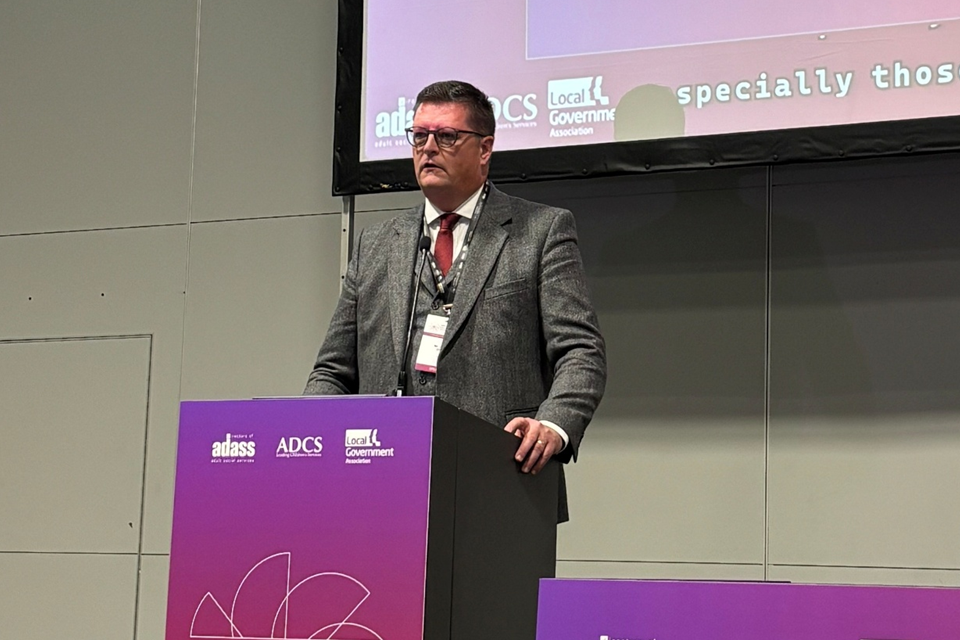
Hello everyone, it’s good to be back here at Liverpool docks with Yvette and all of you.
Part of my job involves speaking at events like this. Standing up in front of dedicated, like-minded people and trying to put the words together to capture the immense sense of purpose we all share – and the scale of responsibility we share, too!
But for me the revelations often come when I’m sitting in the audience rather than standing up in front of one.
In London this summer I sat in the audience alongside Yvette watching a play called ‘A DoL House’. Not the similar-sounding Ibsen play!
This play was created and performed by young people with experience of being deprived of their liberty, and of care.
For Yvette and I it was a sobering, and often sweary, window into our collective failure to create the right support at the right time for young people. Especially those with layers of complex needs.
If you’ve seen it, you’ll know it was performed with such passion, such conviction. It’s stayed with me in the months since.
Now, I can’t act. I’m not here to deliver a dramatic soliloquy.
Instead, I want to share some thoughts and themes that have been on my mind, and for Yvette and I to answer any questions you have.
Reflecting on our consultation
Let me start with the thing that brings us all together in this room in the first place: everything you do is about getting it right for children and young people.
Especially those who need the most support – those represented in ‘A DoL House’, those who are often the most overlooked and who have the most multi-layered and complex needs.
It is our mission to consistently strive to do even better by those children – building on existing good practice to drive standards ever higher. In support of that mission, we recently held our consultation on changes to children’s social care. If you responded to that consultation, thank you.
One of the things we asked you about as part of that consultation was building on what already works well in SCCIF and ILACS:
We wanted to hear about how we can improve on the good work that’s already happening to focus on children’s experiences and progress…
…how to strengthen the enduring professional relationships we already hold with local authorities and providers…
…how we can better enable good practice and identify areas for improvement through focused visits. And, where very significant improvement is needed, provide additional monitoring visits.
We also asked about focusing even more on certain areas:
Such as updating the SCCIF to better highlight the importance of children’s enduring relationships…
…and bringing ILACS even closer in line with the government’s long-term ambitions.
That means getting children and families earlier help by intervening as early as possible, before needs get even greater, and building on family networks to keep as many children as possible safely with their families.
It means improving multi-agency work to better protect children.
And it means looking at how we can set even higher ambitions for children in care and for care leavers.
Collectively, these are big ambitions. I am sure you will agree.
And we have listened to your concerns about what this means for wellbeing.
One way we want to reduce the pressure on leaders is by bringing inspection in line with other settings we inspect. It’s why we asked you about using a 5-point scale and new grades so we can have continuity across sectors and speak with a common language.
This approach would mean we can set out much more precisely what inspectors will be looking for as they gather evidence – giving you clarity as you do your day-to-day work and making sure that all our inspections are consistent, no matter where in the country they take place.
We also asked you for your thoughts on how we propose to tackle the really tough issues we all need to work together on in this remit – like the scourge of unregistered provision. But I’ll get to that in just a moment.
Right now we are looking at all the responses and taking time to really understand everything you’ve told us so we can get these changes right.
I’ll talk more about the next steps at the end of this speech, but first I want to dwell on that theme of ‘getting it right’.
Getting it right for children, young people and families has such incredibly profound consequences – it’s what you’re all striving towards every single day.
Getting it right can make a difference too monumental to measure.
Getting it right changes lives.
Getting it right through oversight
One of the areas where you know we are prioritising getting it right is one I just mentioned: the use of unregistered children’s homes.
As you’ve heard me say before – probably many times by now – unregistered provision is illegal, unlawful provision.
Not only that: it is unregulated, it is unjust, and in the most worrying cases of all it is unsafe.
Our inspectors have discovered children placed by local authorities in Airbnbs and hotel rooms.
They’ve found children being looked after by staff with no experience in childcare and who have not been checked for a criminal record. We worry about some of them having links to organised crime and county lines.
I wrote about this for LBC recently.
I also welcomed Ann Graham’s recent interview on this issue and I know you all share my concern that it is the most vulnerable children, those with the most profound and complex needs, who end up in this type of provision with no regulatory safeguards or independent oversight to ensure they are cared for safely and well.
We know you are working incredibly hard to increase foster care and kinship care – and many of you are working to deliver more local residential care, too.
And we see local authorities making hundreds of calls before they resort to placing children in unregistered homes.
Believe me, those efforts are not in vain. In our recent inspections, we are seeing these numbers decline significantly as your efforts bear fruit.
However, that is not yet the case in all places. We still have work to do together to eradicate unregistered from the system.
Because despite your efforts of due diligence when placing children, despite your efforts to direct children into other forms of care, too often we find bad players motivated by profit rather than by the vocation of wanting to care for children.
They are attracted by the money that desperate local authorities are willing – unwilling, perhaps, but forced – to pay. They rarely attempt to register. And when we do catch up with them, they move and change their name.
The problem is bigger than just these bad players, though. It’s bigger, and it’s much more complex.
It is, as I’ve said before, a problem of not having the right homes, staffed with the right skills, in the right places.
Because in truth, we have a record number of children’s homes registered: over 5,000 as I speak to you now.
To put that in perspective, when I joined Ofsted in January 2024, we had around 3,200.
So, 17 years of Ofsted registration with around 3,000 homes. Yvette and I have doubled the size of the team and registered 2,000 more in less than 3 years.
It’s driven by record numbers of applications: we used to get something like 30 to 50 applications a month. We now get 150 to 170 a month. The backlog of registration is going up and up. It stood last week at 1,082.
Sadly, those numbers don’t always represent the type of care you want to place children in, and that we so desperately need.
We recently published our prioritisation policy. That policy is helping us to focus on the homes in the right places and for the children who need them most, for example those leaving secure children’s homes or a hospital after a long stay.
But those 150 to 170 applications that come in every month are still not meeting the prioritisation criteria. Only about 6% to 10% currently are. Those are the ones we are focusing on.
In general, the applications we’re getting are also of a very poor quality. We need more capacity to deal with them and clear this backlog.
So we have more than doubled our staff. We’ve recruited inspector assistants to enable inspectors to focus on the decision making rather than processes. We have commissioned a new regulatory system so applications can be processed more quickly, and providers can now see the progress of their application.
We will continue to focus first on applications where they’re needed while we chip away at the rest of the backlog.
All this is happening while we have around 5,000 empty beds in this country.
We know many of these beds aren’t going to be used as planned – ratios adjust for children with more complex needs and a home built for 4 can quickly become a space for just 2 children or even just one. That’s not a scenario we want to see either, where children are isolated in care.
It shows the scale and intricacy of the problem, how we need to look really closely at the map and the most critical areas and do what we can alongside you, government and the many great and legitimate providers out there to eradicate the use of unregistered children’s homes.
Yvette and I spoke to many fabulous providers, including providers of children’s homes, at the Children’s Homes Association recently.
So as part of that we are considering your responses to our consultation very, very carefully.
We will want to see that you’re doing all you can to stop using unregistered provision and that you are making progress away from it.
When inspectors visit, we wholeheartedly want them to be able to report back on the distance you’ve travelled – the ever-tighter grip you’ve managed to get on this problem.
You may have seen that we also had our first successful prosecution this year. It’s a huge milestone and we are sending a very, very clear message that breaking the law in this way will have consequences.
There will be more prosecutions – and very soon. We have invested in a bigger team, including former police officers, so that we can continue to prosecute and start to fine providers who continue to not register their homes.
I have said that it is a complex picture. A large part of Ofsted’s role is to look at that picture and see where bits are blurry – where the system has issues and gaps.
We need to spot the issues that go beyond any one local authority. The problems that we can only solve when we work together. Unregistered is one of those problems and we will use all our powers to eradicate it and to get this right for children. We know you don’t want to use them.
Getting it right for children and young people with SEND
Another area we know we need to get it right is for children and young people with SEND. That looks different for every child.
The Department for Education has confirmed we won’t inspect under a new Area SEND framework until new legislation is enacted.
We need to wait for statutory and non-statutory guidance that will underpin any change to that framework. That’s not planned until autumn 2029.
We have been asked to continue Area SEND inspections in their current guise until any changes come into play.
Because these children’s and young people’s needs don’t go on pause – their right to high-quality support can’t wait. We still need to know what their experiences are like.
Until then, our current expectation is that every local area partnership will have been inspected at least once under the current Area SEND framework by the end of 2027.
We’re on track to achieve this and our reports highlight to parents and carers the great work that is going on across England. My annual report comes out in December every year, and we’ll talk about this in the annual report this year.
This is even more important during times of change. Our findings must help explain the impact of reforms on children’s experiences and direct targeted support toward where it’s needed.
Our Area SEND inspectors ask pressing questions to learn about children’s and young people’s experiences: Are their needs identified early enough? Can they access the specific services they need, when they need them? Do their parents, carers and families feel heard and involved?
If we were to pause inspections – if we were to stop asking these questions – we risk opening up an accountability gap for those who most need assurance that their education, health and care services are tailored, appropriate, safe and supportive.
We know that this framework has been a catalyst for improvement. Our reports, and thematic reports, have driven change across the system – from Gloucestershire to Norfolk to Sefton and beyond.
We have to keep up this work and this accountability, so no child or young person slips through the net while reforms are happening. We want to get this right, and we want to do it with you.
We’ve already started to meet with leaders from education, health and care as well as parents, teachers, therapists and children and young people with SEND.
Worthwhile change can’t happen overnight. So I look forward to continuing those conversations as we all work together to get this right.
And, as Ann wrote to me recently, to consider the footprint of inspections on all of you.
Getting it right through working together
Because we all know it takes a village to raise a child.
You lead the local systems which impact on the life choices and chances for your children and families.
But, through our Area SEND inspections and JTAIs we shine a light on the issues that no institution or organisation can crack on their own.
Where sometimes you feel held accountable for another partner’s absence or lack of focus on children and families, we are hearing you.
That is one of the things we will look to improve in our new area SEND inspection framework, when we have that strong new guidance from government to back us.
We occasionally get asked how most schools in a local area can be doing well on inclusion if a similar result isn’t reflected in Area SEND inspections.
The answer is that schools are a single entity.
They might be getting it right for the children they have on roll – but when we look at the wider system and partnership across education, health and social care, we’re looking at different metrics, pathways and processes.
On the other hand, sometimes local areas have established a great strategy that is working well for children and young people with SEND, but some individual schools are not engaging with you.
We need to ask: are some children falling through the gaps, are some being left behind?
We have asked for improved guidance that sets out responsibilities across those areas – so we can better identify who needs to improve what and report fairly on that.
The EOTAS guidance, which was a recommendation from our report ‘children with SEND not in school’ is one example of a positive first step in that direction.
Everyone here forms part of the puzzle. When all our pieces fit together correctly, when we close the gaps and provide that seamless support, when we have distinct responsibilities and accountability – only then do we have a full, complete and coherent picture for the children we are all here to serve.
Conclusion
So what happens next?
We will publish our response to the consultation early next year, followed by our new inspection materials.
We expect all ILACS changes to be implemented from spring 2027.
Throughout all these next steps we will continue to focus, always, on getting it right for children and young people. And we will back you to do exactly that.
Because you know what works. You are the ones working every day, in really difficult and challenging circumstances, to ensure that children get the quality care they deserve.
For example in Haringey, that quality care is the result of being ambitious and creative in response to budget pressures. Early help in this local authority is reducing harm across all age groups. Most children in care are in stable, well-matched homes, and care leavers have positive relationships with their workers.
In South Tyneside, that’s meant turning inadequate children’s services around so that children now receive good support and protection. Services for care leavers are a particular strength. Crucially, leaders know exactly what still needs to improve and are clear about their plans to do so.
In Hertfordshire, that’s visible in leaders’ relentless ambition for children to thrive. They have built a culture where staff are valued and get the training they need to best support children and young people. Most children there live in high-quality homes. They’re helped to return home safely and are supported by their family networks wherever possible.
And in Essex, strong and stable leadership, well-established governance systems, clear strategic aims and effective partnerships are the basis of flourishing good practice. Every decision is made with children in mind and it shows up in their experiences being improved every day.
It brings Yvette and I so much pride and joy to read and share positive reports like these.
These councils show – as do many, many more of you – that ambition works. Strong leadership works. Early help works. Good partnerships work. Stability works. Care works.
It’s all down to your hard work.
Thank you for everything you do, Yvette and I are ready to take your questions.