Security Minister speech at the IPCO Conference
Security Minister, Dan Jarvis, delivered a keynote speech at the Investigatory Powers Commissioner's Office (IPCO) Conference in London.
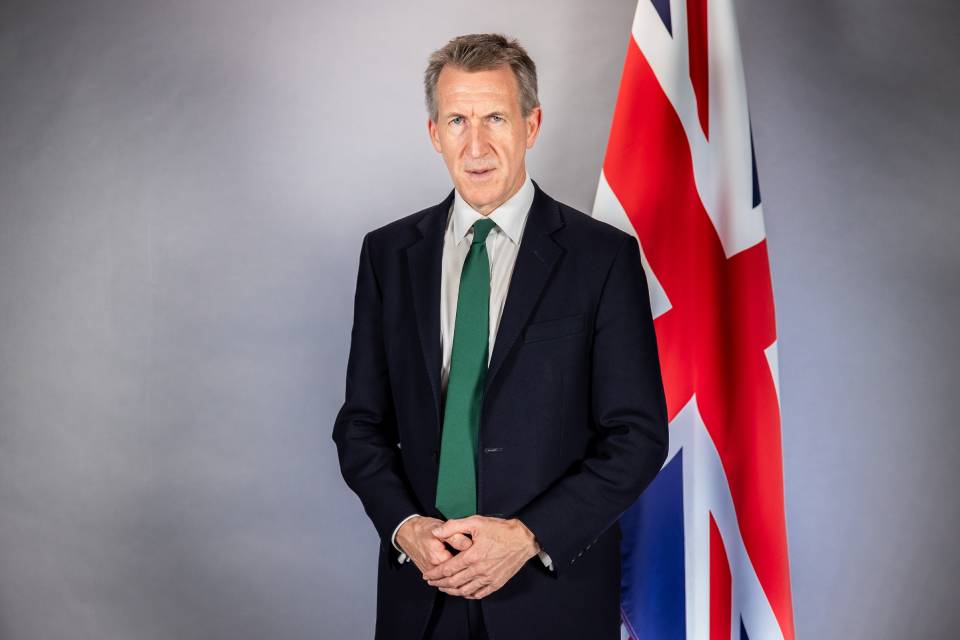
Good morning everyone. It is a real pleasure to join you all here today, and I’m very grateful to the Investigatory Powers Commissioner’s Office for inviting me.
I must admit though, when I first heard I’d be addressing an audience of lawyers, journalists and intelligence experts, I did quite wonder what I’d let myself in for.
After all, as a government minister, it’s an audience that gives you very good reason to choose your words very carefully.
The lawyers will be listening for what I say.
The journalists will be listening for what I don’t say.
And the intelligence experts?
Well, they may have known what I was going to say before I did.
But regardless, it really is a great privilege to be here.
Not least because this conference marks an important anniversary - ten years of the Investigatory Powers Act. Or the IPA, as it’s known.
Although I suspect this is one of the few rooms in London where those three letters are more likely to prompt a discussion about legislation than beer. And rightly so.
Because over the past decade, the world has changed considerably, the threats facing our country have evolved, and the importance of effective intelligence capabilities has only grown.
From my previous time in the Armed Forces, and now as the Security Minister, I know just how important those capabilities are for keeping our country safe.
But I also know that with such significant powers comes a responsibility to ensure they are exercised lawfully, proportionately and with proper independent oversight. That is what makes the Investigatory Powers Act so important.
And it is what makes the work of the Investigatory Powers Commissioner’s Office so essential. So, before I turn to the Act itself and its continued relevance ten years on, I want to take the opportunity to pay tribute to those who have worked tirelessly over the past decade.
Providing the independent oversight that is so integral to both the spirit and substance of the legislation. I am talking, of course, about our hosts: the dedicated staff of the Investigatory Powers Commissioner’s Office; the Commissioner himself Lord Leveson; and his predecessor Sir Adrian Fulford.
It is testament to their contribution over many years that this conference sold out, was moved to a larger venue, and then sold out again.
So, interest has been very strong.
I am sure the IPA abbreviation had nothing to do with it.
But if anyone has turned up expecting discussion about Indian Pale ale, I’m afraid this might not be your scene.
Then again, the day is yet young.
Seriously, to the Commissioner and everyone who has made today possible, you have my sincere gratitude.
Now, it was on the 29th of November 2016 that the Investigatory Powers Act became law.
And yet on that anniversary in just a few weeks’ time, most of our fellow citizens will carry on their lives totally unaware of the significance.
We in this room know differently.
We know it was on that date a decade ago that the legislative basis of truly vital powers was established.
Powers that are keeping millions of people safe – even as we gather here today.
And we should recognise that the passing of the Act was a transformative moment.
Not just in the fields of national security and law enforcement.
But for our democracy itself.
And while much has changed since then, the animating force behind that groundbreaking legislation endures:
Ensuring our police and intelligence services have the tools and data they need to tackle the gravest threats.
As well as the consent and confidence of the public as they go about that critical task – all in an increasingly digital world.
The upcoming anniversary marks the achievement of Royal Assent.
But the journey to that point merits mention too.
Because some Bills take a bumpier path to the statute book than others.
And this was certainly one of them.
After all, this Legislation arrived at a moment of great political controversy.
Edward Snowden’s aim, perhaps, was to undermine trust in our intelligence services, and put their mission out of reach.
Instead, calm and purposeful bipartisan cooperation catalysed a step change in transparency;
A movement towards public confidence;
And the resultant shoring up of our most crucial capabilities.
The main controversy, at the time, was about the bulk powers which were to be regulated in parts 6 and 7 of the Act, and available only to the intelligence services.
Much of the criticism was unfounded – as the then Shadow Home Secretary, a certain Rt Honourable Member for Leigh, as his constituency was back then, recognised.
I wonder what he is up to these days.
Anyway, he stood up at second reading for the Labour opposition and said that this Act was neither a snooper’s charter, nor a plan for mass surveillance.
He was right.
And reflecting now, a decade on, we may confidently declare that the idea of the IPA has stood the test of time.
Its impact is undeniable.
Looking at just one power – the targeted acquisition of communications data – more than 350,000 requests were authorised in 2025.
This included over 50,000 for violence against the person, nearly the same for sexual offences, and over 100,000 for drugs offences.
These are some of the most serious forms of criminality, and the source of immense harm in our society.
But statistics only tell part of the story.
So let me illustrate the point with a recent real-life example: the successful prosecution of an individual who plotted an attack on our Jewish community.
This was an extremely serious case – with police searches uncovering instructions on how to make mustard gas, as well as weapons including a crossbow and combat-style knife.
Data acquired under our Data Access Agreement with the United States – relying on powers Lord Leveson oversees – helped demonstrate that the individual had shared extreme terrorist content and expressed his desire to carry out a terrorist attack.
On the strength of this evidence, he was convicted and sentenced to life imprisonment in January.
This is just one of the innumerable instances that illustrate the debt we owe to the police and the intelligence services.
It is the highest honour of this role to serve alongside them.
And to see every day their devotion to the most sacred duty of the state:
Keeping our fellow citizens safe.
And in reflecting on the IPA, we are reminded of a critical truth about that work:
Even if the public are unaware of its detail, they must still have confidence that the agencies charged with protecting them are acting lawfully and with the utmost probity.
And that appropriate guardrails are in place to prevent abuse or misuse of what are among the most sensitive and intrusive powers available to the state.
The organisations to whom we entrust this awesome responsibility contain public servants of the highest calibre.
They serve with courage, professionalism and purpose every single day.
And they do so with absolute commitment to the rule of law and the democratic principles of our society.
We hold them, rightly, to the highest possible standards.
But for all the focus on the powers it confers, the IPA was more than a vehicle to strengthen national security and law enforcement capabilities.
It brought unprecedented transparency around previously unpublicised methods.
Rigorous new safeguards.
And, crucially, a world-leading system of independent oversight.
Lord David Anderson’s groundbreaking report, which led to the IPA, was called “A Question of Trust”.
It made clear that, in a democracy, the transparent and trusted operation of our most intrusive powers is crucial.
That is why we must never underestimate the importance of the checks and balances provided by the Investigatory Powers Commissioner and his Office.
From individual requests for the most basic subscriber data – whether these are made by local authorities for the purpose of protecting our society from fraud, or by our intelligence agencies to unravel a terrorist plot;
To the overarching obligations the Secretary of State is empowered to place on telecommunications operators, to ensure that the data those investigators need is not prematurely deleted, or is available in intelligible form;
And everything in between – Lord Leveson and his office are there to make sure that every single move is necessary, proportionate, and lawful.
Necessary. Proportionate. And lawful.
The Commissioner is no rubber stamp – as those operational partners in this room know only too well.
With his cadre of inspectors, he is constantly checking that every public body subject to IPCO oversight – including the Home Office – has followed the rules.
Working with them constructively to safeguard the rights and freedoms that underpin our democratic society.
This is crucial work. And it must be seen to be done, which is why the Commissioner’s annual report is so important.
This matters, of course, because it is integral to our democratic way of life.
The measure of a free society is its willingness and ability to stay true to its principles.
Even when the stakes could not be higher.
Action taken in extreme circumstances – and with the noblest of intentions – must still be subjected to the sunlight of scrutiny.
Not just because the law requires it.
And not just because transparency promotes excellence.
But because, at a time when rights we take for granted are still denied to many around the world, our nation must lead by example.
That means striving always to strike the right balance.
Knowing as we do that privacy and security is not a binary choice.
And it also means working closely together.
Across national borders and across sectors and services.
That is why I am so pleased to see such a wide range of fields represented here today.
With attendees from across government, law enforcement, civil society and academia, the turnout speaks to the kind of whole-of-society effort this issue really demands.
I also want to take the opportunity to thank our closest allies.
In particular, the United States – the counterparty of our transformative Data Access Agreement.
But also, other Five Eyes countries, the G7 – including the European Commission – and our colleagues in Sweden, with whom we are delighted to be hosting the second International Symposium on Lawful Access in Stockholm next week.
As the most dangerous threats cross borders in ways barely imaginable a generation ago, these partnerships are indispensable.
Because the only people who gain from gaps in our response are those who mean us harm.
Now, before I wrap up, I want to thank Lord Leveson and his team once again.
For bringing us together today – and for the very important work that they do.
They may not themselves investigate terrorist plots or pursue criminals.
But by providing independent authorisation and rigorous oversight of those who do, they allow those criminals to be caught and those terrorist plots to be stopped.
In our democracy, they play a fundamental role in keeping our country safe and keeping our public confident.
And I thank them again for it.
Having begun by reflecting on the IPA’s arrival a decade ago, let me finish with a thought about the future.
Because we do not yet know what the defining story of this century will be.
Nor can we predict with any certainty how the world will look when the Act reaches its 20th anniversary – in the same way that in 2016, we could not have foreseen the landscape in 2026.
The ceaseless march of technology – exemplified by developments around AI, alongside an ever-escalating threat picture – will have profound effects on the technical environment we operate in, and we will need to keep the framework under constant review.
But we will always be guided by our expectation that those providing communications services to our citizens, wherever they are located, do not also provide a means to hide from justice.
And we can also be certain of this:
Whatever challenges may come, we will only meet them by staying true to our most trusted values.
That means working relentlessly to keep the public safe.
And it means protecting the democratic way of life we rightly cherish.
Because security and democracy are indivisible:
Two sides of the same coin.
And the common purpose uniting all of us here today.
Thank you.