Rarely a day goes by without hearing the words ‘artificial intelligence’. From news reports to boardroom strategies to conversations during the daily commute, AI seems to be everywhere. And a day in government is no different.
Policymakers in Whitehall want to scale up AI adoption to transform public services. The Prime Minister's new AI Taskforce is the latest sign of this ambition. But we still know very little about what it actually takes to deploy and evaluate these technologies in the public sector.
Our Test, Learn and Grow (TLG) accelerator on AI and data for children’s services is trying to change that by working directly with local authorities to ‘test’ how AI can improve services before committing to rolling anything out at scale. The Government Outcomes Lab works as TLG’s independent learning and evaluation partner.
Clare and Ashna both work on the accelerator. Clare oversees the accelerators work day-to-day with Barnsley partners and Ashna brings her evaluation expertise - observing how the work evolves and feeding back learnings that could help others adapt and scale similar projects elsewhere. In this blog, they share three early learnings from Wave 1 of the accelerator’s work.
Why Barnsley, why now?
A local authority is where most citizens engage tangibly with the state. It is where families access essential services; from housing, education, health and social care, to benefits, tax, and safeguarding. But local authorities are busy, complex, multi-layered organisations.
The number of looked after children has increased 70% in 30 years, now consuming a quarter of Local Authority service budgets. In 2025, Barnsley had 56 children in external residential care placements, costing £0.5m per child a year in April 2026.
We know we want to improve public services so they work more efficiently, are better connected to local communities and improve lives. However, without testing an idea or plan using a prototype, it becomes impossible to know whether AI might play a valuable role, and the risks it might pose for residents accessing public services.
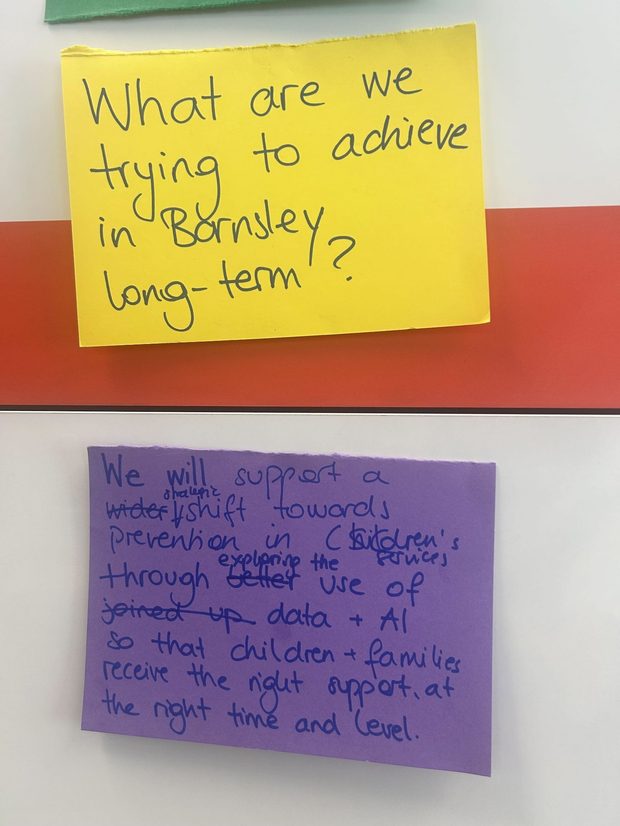
This accelerator is working closely with partners in Barnsley to explore whether council teams can use data and technology to take a more prevention-focused approach to service delivery, so that at-risk children and families in Barnsley receive the right support, at the right time and avoid care placements.
This work is also taking place as Barnsley becomes the UK’s first government-backed Tech Town. Tech Town is a partnership between central government, Barnsley Council and local organisations, set up to explore practical, AI use cases that originate in place. The ambition is for Barnsley to act as a trailblazer, testing how AI can tackle bespoke challenges in different sectors, and as a result, improve everyday life while keeping change rooted in local priorities, institutions and residents’ perspectives.
That work is already underway: from new AI skills and training programmes for residents, workers and businesses, including the AI Upskilling Challenge Fund and the AI Career Launchpad. Barnsley Council is also developing The Seam Digital Campus and National Centre for Digital Technologies, and offering programmes such as Ignite AI and Meld AI to help local businesses build the confidence and capability to use AI. Together, these Tech Town initiatives make up the wider context and local conditions in which the TLG Accelerator is working. For evaluation, it is important to monitor how this wider activity may influence the accelerator’s progress.
Three early lessons
After starting in December 2025, most of the accelerator’s early work involved conducting sessions with Barnsley Council and frontline services to understand the issue and design a clear roadmap for this work.
Learning 1: Defining the right problem to focus on takes time, and involves a lot of people and decision making
Working out the exact scope of the problem and finding the right people to talk to at different levels of a local authority is crucial. Before testing anything, the accelerator has recognised the value of doing relational work first:
- mapping who the relevant stakeholders are
- coordinating different council teams and building a shared vision
- running several consultations with practitioners to understand the challenges they face and get feedback on ideas
- building strong relationships with senior council leaders, and earning their trust and buy-in
The learning generated from this ‘discovery’ process has opened up more questions, such as:
- How narrowly or broadly should the scope of the problem be defined?
- Is this a data quality problem that can be solved without AI? Or a prediction problem that AI could help inform?
- Will this work build resilience and influence decision-making in Barnsley’s local system in the long-term, and last beyond TLG?
Learning 2: Being willing to change course is a good thing, and perhaps the very essence of doing ‘test and learn’
A couple of months in, the accelerator made a deliberate decision to change focus and pivot from their original plans, which was improving productivity for frontline staff in the council.
This happened after several conversations and brainstorming exercises with place partners, who understood that frontline teams in Barnsley often work in crisis mode. The question became: could a more targeted, strategic intervention create change in an organisation constantly trapped in crisis?
They used this insight to shift the focus to strategic-level stakeholders, to help develop a shared ‘service delivery transformation ambition’ for the council.
Although this decision to pivot caused a temporary drop in confidence levels for the accelerator team, having this insight from frontline teams meant that this was valuable learning and a useful course-correction early in the process.
Learning 3: Data and AI solutions can’t be adopted in isolation from the wider institution
The accelerator’s own pace of technology adoption can only move as fast as the local authority - as an institution and system - is able to absorb it. Institutional practice and organisational culture matter just as much as the technology itself. For this accelerator, this has meant understanding:
- how a council organises its services
- how the accelerator’s plans feed into or overlap with other similar cross-government initiatives
- how different council teams communicate with each other

Without understanding how their ‘test and learn’ work interacts with these local conditions, it is hard to say what is working and what needs to change.
Evaluating a moving target
As a team of evaluators, we are in a unique and unusual position. In traditional government evaluation, findings are often published at the end of a programme. The Government Outcomes Lab is part of a live TLG partnership, so we can share learning as we go, and the programme can act on it in real time.
This also makes us think carefully about our role in a programme where the work keeps evolving. What counts as good evidence? How do we balance the flexibility an agile accelerator needs with the rigour a robust evaluation demands? What outcomes should we hold a reform programme accountable for, when it's built on learning from failure as much as success? We'll return to this in a future post.
What’s coming next
A lot of what we have seen so far is likely to change as the accelerator’s work progresses.
We expect that insights from Barnsley will help us understand how to approach AI implementation in other regions and types of services.
Want to learn more or get involved?
- Join the Test, Learn and Grow Linkedin Community, where the accelerator routinely shares weeknotes about its work-in-progress, in the spirit of ‘working in the open’.
- Sign up to receive alerts for our latest blogs.
- Have any questions or ideas? Get in touch: Clare Holden (Cabinet Office, clare.holden@cabinetoffice.gov.uk), Ashna Devaprasad (GO Lab, ashna.devaprasad@bsg.ox.ac.uk)
Leave a comment