8th UK-Taiwan Energy Dialogue and 21st UK-Taiwan Renewable Energy Conference
The conference advanced cooperation on energy security, offshore wind, and carbon capture, utilisation, and storage (CCUS).
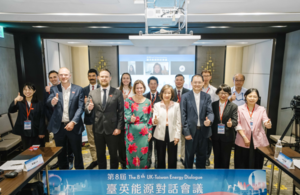
The eighth UK-Taiwan Energy Dialogue and 21st UK-Taiwan Renewable Energy Conference were held in Taipei on 20 October, bringing together policymakers, regulators, industry representatives and experts from the United Kingdom and Taiwan to deepen cooperation on energy security, offshore wind and industrial decarbonisation.
The Dialogue was organised by the British Office Taipei and Taiwan’s Energy Administration, Ministry of Economic Affairs. The event was opened by Ruth Bradley-Jones, Representative at the British Office Taipei, and Cynthia Kiang, Deputy Minister of Economic Affairs, and chaired by Simon Payne, Head of International Bilateral Cooperation at the UK Department for Energy Security and Net Zero, and Chih-Wei Wu, Director General of Taiwan’s Energy Administration.
It focused on shared energy-security challenges, offshore wind deployment, and carbon capture, utilisation, and storage (CCUS). It also marked the launch of the new UK-Taiwan CCUS Partnership under the Energy and Net Zero pillar of the Enhanced Trade Partnership.
Opening the Dialogue, Ruth Bradley-Jones, Representative at the British Office Taipei, said:
The challenges we face – energy security, climate change and the growing demands of a digital economy – do not stop at our borders. Nor should our ambition.
She highlighted the increasingly close relationship between energy security, economic security and the energy transition, and welcomed the launch of the UK-Taiwan CCUS Partnership as a step forwarding bilateral cooperation. She noted that growing electricity demand, including from AI-enabled technologies, reinforces the need both to expand renewable-energy deployment and develop solutions to decarbonise hard-to-abate industries.
She added:
The Partnership we are launching today under our Enhanced Trade Partnership will bring structure and momentum to that burgeoning relationship. It will help build the sustained institutional links, regulatory understanding, research connections and business partnerships required for success.
In her opening remarks, Deputy Minister Kiang said:
In the face of geopolitical tensions, extreme weather events and volatility in energy markets, energy security is inextricably linked to the net-zero transition.
On the new CCUS Partnership, she added:
Taiwan and the UK will also exchange views on CCUS policy and technological developments at the Energy Dialogue this year and will continue to discuss opportunities for collaboration.
Launch of the UK-Taiwan CCUS Partnership
A key outcome of this year’s Dialogue was the launch of the UK-Taiwan CCUS Partnership, a flagship project under the Enhanced Trade Partnership and a new framework for cooperation on carbon capture, utilisation, and storage. The Partnership reflects a shared recognition that CCUS can play an important role in industrial decarbonisation, supporting hard-to-abate sectors while helping deliver net-zero objectives and maintain economic competitiveness.
The Partnership intends to strengthen cooperation between policymakers, regulators, industry, investors and research institutions, and support the development of commercially viable CCUS ecosystems in both markets.
Cooperation is expected to focus on three workstreams:
- policy and regulatory cooperation, supporting exchanges on policy design, regulatory frameworks, financing models and approaches to enabling CCUS deployment
- technical cooperation on research, innovation and deployment, connecting researchers, technical institutions, and clusters to address key questions around storage, monitoring, and verification
- commercial pipeline and investor engagement, exploring, at an appropriate time, opportunities to connect companies, investors and project owners, build partnerships and support future project development
The Partnership, as with other initiatives under the ETP, will be overseen by senior officials from both sides and supported by working-level leads. Over time, a joint secretariat will be established to coordinate activities and monitor delivery across the three workstreams.
Participants welcomed the launch as a significant step in expanding UK-Taiwan cooperation on industrial decarbonisation and clean energy innovation, building on more than two decades of bilateral collaboration in offshore wind and renewable energy.
Dialogue sessions
The Dialogue consisted of three sessions covering energy security, offshore wind and CCUS. Discussions combined UK and Taiwan perspectives, highlighting shared challenges, policy approaches and opportunities for deeper bilateral cooperation.
Energy security
In the first session, Simon Payne, Head of International Bilateral Cooperation at DESNZ, presented on the impact of the Strait of Hormuz crisis on the UK’s energy transition. He said recent market disruption reinforced the UK’s view that clean energy deployment strengthens energy security by reducing exposure to international fossil fuel price shocks, while also supporting affordability and climate goals.
Mr Payne outlined how the UK is responding through measures to support consumers, strengthen system resilience and accelerate investment in domestic clean energy. He also highlighted the role of renewable generation, market design and long-term infrastructure planning in improving national resilience.
Fang-Ling Liao, Director of the Energy Policy and Climate Change Division at Taiwan’s Energy Administration, set out Taiwan’s response to two linked challenges: rising electricity demand from AI and semiconductor supply chains, and geopolitical risks to fuel supply. She outlined Taiwan’s Second Energy Transition, focused on diversified green energy, efficiency, storage and grid resilience.
Ms Liao also described practical steps to strengthen energy security, including regular reviews of long-term power demand, additional gas-fired capacity, stronger requirements for large data centres, emergency response arrangements, diversified fuel supplies and strategic reserves.
Offshore wind cooperation
During the offshore wind session, Luke Rawcliffe presented an overview of the UK’s offshore wind programme and recent policy developments. He highlighted the UK’s 16.7 GW of installed offshore wind capacity, its ambition to reach 43-50 GW by 2030, and the sector’s growing role in supporting energy security and net-zero objectives.
Mr Rawcliffe outlined the UK’s Contracts for Difference mechanism, including the results of Allocation Round 7, which secured a record 8.4 GW of offshore wind capacity. He also discussed the next phase of deployment, including floating offshore wind, grid expansion, supply chains, planning and port infrastructure.
Ju-Ming Cheng, Director of the Energy Development Division at Taiwan’s Energy Administration, reviewed Taiwan’s offshore wind progress, with around 5 GW now installed and 515 turbines in operation as of 1 October 2026. She set out Taiwan’s 2026-2039 plan, including further allocation rounds, regular releases of new capacity and scope for additional projects through cross-government coordination on available sites.
Ms Cheng highlighted the priorities for the next phase of development, including clearer policy, stronger local supply chains, improved financing, faster administrative processes and preparation for floating wind demonstration projects, reflecting Taiwan’s continued focus on offshore wind as a central part of its net-zero pathway.
Carbon Capture, Utilisation, and Storage
In the third session, Shyam Desai, Head of Economics at the British Office Taipei, outlined the framework and three workstreams for the UK-Taiwan CCUS Partnership, as described above.
Chloe Healy, Industrial Carbon Capture Strategy Lead at DESNZ, outlined the UK’s approach to deploying CCUS, including lessons from earlier programmes and the tailored business models developed for capture, transport and storage. She highlighted progress on the HyNet and East Coast clusters, the role of shared infrastructure in decarbonising hard-to-abate sectors such as cement, and plans to expand deployment through further clusters while strengthening domestic supply-chain capability.
Ciao-Kai Liang, Section Chief at the Climate Change Administration, Ministry of Environment, presented Taiwan’s approach to CCUS as a key enabler of its net-zero transition, particularly for hard-to-abate industries. He outlined the CCUS Flagship Carbon Reduction Action Plan, which aims to reduce emissions by 6 million metric tonnes of CO₂e annually by 2035 through policy and regulation, technology development, financial incentives, green investment and international cooperation.
21st UK-Taiwan Renewable Energy Conference
The Conference brought together policymakers, industry leaders and energy experts to explore the opportunities and challenges shaping the next phase of the energy transition. The conference featured contributions from Greg Gardner, Richard Burch, Simon Payne, Chloe Healy, Richard Baker, Gus Jaspert, Chong Ng and Fraser MacDonald, representing the Department for Business, Innovation, Science and Trade, the Department for Energy Security and Net Zero, Scottish Development International, The Crown Estate and Offshore Renewable Energy Catapult, alongside representatives from 13 leading UK companies. Discussions focused on emerging priorities such as CCUS, grid resilience in the AI era, and offshore wind development, including floating offshore wind, subsea cable technologies, operational optimisation, and marine services.
Building on more than two decades of successful renewable energy cooperation, the UK stands ready to deepen its partnership with Taiwan, combining expertise in offshore wind, grid resilience and emerging energy technologies with stronger commercial, investment and innovation links that support long-term energy security, industrial decarbonisation and sustainable economic growth.