Shortly after midnight (UK time) on 26 October 26, NASA launched a pair of spacecraft that would change our perspective of the Sun.
20 years later, the Solar Terrestrial Relations Observatory (STEREO) mission continues to deliver crucial data for scientific research as well as for operational space weather forecasting – essential for understanding and mitigating the impacts of solar activity on technologies we rely on here on Earth.
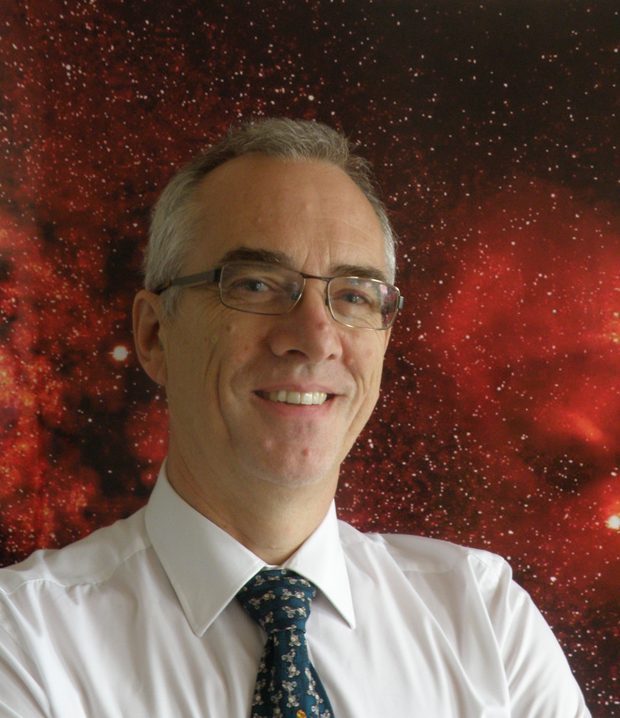
To celebrate this anniversary, we spoke to leading solar scientist and Visiting Scientist at RAL Space, Professor Richard Harrison, to learn more about the mission and his involvement.
Why did we need a twin-spacecraft mission like STEREO?
As humans, we see in stereo because we have two eyes. The image from each eye is slightly different and our brain, by combining the two images, gives us much more than a flat picture by adding some perception of depth. The concept for the STEREO mission is the same.
The two STEREO spacecraft were designed to carry identical sets of instruments in order to “see” in three dimensions. This included a pair of Heliospheric Imagers led by the Rutherford Appleton Laboratory (RAL) Space Department, now known as RAL Space, which were designed to look at the space between the Sun and the Earth.
The HI instruments see the vast clouds known as Coronal Mass Ejections (CMEs) as they erupt from the Sun and travel through space in the inner Solar System. With an identical instrument on each spacecraft, we could study the three-dimensional structure of these CMEs, which improved our understanding of their direction of motion, and therefore our ability to identify events that might impact Earth. This is important because the arrival of CMEs at Earth drives so-called “Space Weather” impacts that can have detrimental effects on a range of human systems and activities, including power grids, communications systems, and satellites in orbit.
How did you come to be involved with the mission, and what did your role involve?
I was part of the European study group in the 1990s that recommended a STEREO-like solar orbiting multi-spacecraft mission, but it was NASA that brought the STEREO mission to fruition.
I’m a solar physicist and was leading an instrument aboard the ESA/NASA Solar and Heliospheric Observatory (SOHO) mission at the time. The STEREO Heliospheric Imagers were then being led by Professor George Simnett from the University of Birmingham, working closely with the RAL group. In 2002, Professor Simnett stepped down and I was asked to take on the Principal Investigator (PI) role.
An instrument PI is the formal lead of an instrument on a spacecraft. They are responsible for development, operation and scientific exploitation of the instrument, overseeing a team of scientists, engineers and technologists. They are also the prime communicator to the funding agency (PPARC, and then the UK Space Agency in our case), and participate in mission-wide planning, coordination and management.
As PI, I led the team that included staff at RAL, the University of Birmingham, the US Naval Research Laboratory and the Centre Spatial de Liege (Belgium) from 2002, through to launch in 2006 and then for mission operations up to my retirement from RAL Space in 2023.
I had the great pleasure of working with an excellent team of people. In particular, I’d like to acknowledge the superb support of the STEREO Heliospheric Imagers’ Instrument Manager Chris Eyles and the Project Scientist, Jackie Davies, who has since taken on the PI role. Building and operating a space instrument is very much a team effort.
What makes STEREO unique compared to other missions you’ve worked on?
The two major missions that I was involved with before STEREO were NASA’s Solar Maximum Mission (1980 to 1989) and the Solar and Heliospheric Observatory SOHO (SOHO, 1995 to date), both of which enabled ground-breaking observations of the Sun, viewing the hemisphere facing the Earth.
Two elements of the STEREO concept are worth noting here. First, with two spacecraft both in a solar orbit, there are times when they are on opposite sides of the Sun from each other, and so for the first time in history, we saw the entire surface of the Sun. Putting that another way, for the first time we could see the entire surface of a star. This had never been done before.
Second, even with only one STEREO spacecraft, orbiting the Sun (at the distance of the Earth) means that we are usually outside the Sun-Earth line. This means that we can see CMEs propagating outwards towards Earth from the side, enabling studies of Earth-directed CMEs as never before. This opened a new chapter in studies of our star.
So, the STEREO concept provided many firsts, and it has delivered, taking centre stage in pioneering the physics and required techniques for space weather applications.
Have there been any particular challenges during the mission?
For the first 8 years of operation, both STEREO spacecraft operated successfully. However, in 2014 we lost contact with one of them, and since that time have operated with just one.
On the face of it, the loss of a spacecraft sounds like the end of the mission. However, it should be noted that the mission had already been a major success and was well into an extended phase of operation.
Also, with the application of clever analysis techniques, the scientific return from the one remaining spacecraft has been excellent and continues to address the key goals of the mission. Indeed, the success of the mission has been a major influence in planning the concept for the European Space Agency’s Vigil mission, which is currently under development.
Are there any moments from STEREO that stand out to you?
Seeing the first HI images with clear CME observations, right from the start, was one of the most exciting results. Simply achieving that was a major success, because imaging such a diffuse phenomenon using baffle systems to cut out scattered light from the Sun and the Earth showed that we had a superbly engineered instrument.
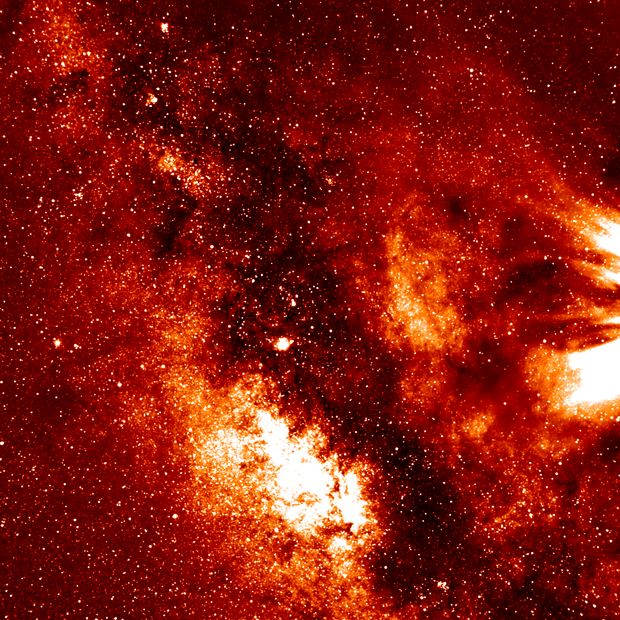
Having said that, when we first opened the doors, the first images showed us a truly magnificent image of a comet almost filling the frame with its highly structured tail. Quite a sight! The remaining HI does still see comets, and many research papers have addressed these observations, even though it is outside the core research area of the mission.
What I am most proud of is the fact that we were the first to ever image the space between the Sun and the Earth, with our vantage points outside the Sun-Earth line. We went on, subsequently, to successfully image Earth-directed CMEs and to utilise such observations to provide pioneering input to future space weather missions.
You’re retired now – but are you still keeping an eye on what’s happening in the world of solar physics?
A research scientist’s career is extremely personal in many ways. Whilst you are involved in science missions, your own research is a personal journey. I was a professional solar physicist for 44 years, specialising in research into the physics of the Sun’s outer atmosphere and CMEs. Even though you retire, your personal research was yours and you never really leave it. I still keep an eye on the solar and space weather fields.
Also, the missions you are involved with you clearly care about, so I do keep an eye on them. In fact, I do continue to participate in a few space-related projects and the beauty of being retired is that you can do that when and if you want to! I am delighted to see both SOHO and STEREO (the missions on which I was leading instruments) continuing. I am also particularly delighted to see the two solar encounter missions, ESA's Solar Orbiter and NASA's Parker Solar Probe breaking new ground. I look forward to ESA’s upcoming space weather mission, Vigil, which will build on the path opened up by STEREO. I am excited by the prospect of a future mission flying over and imaging the solar poles.
Leave a comment