PM speech in Scotland: 16 October 2026
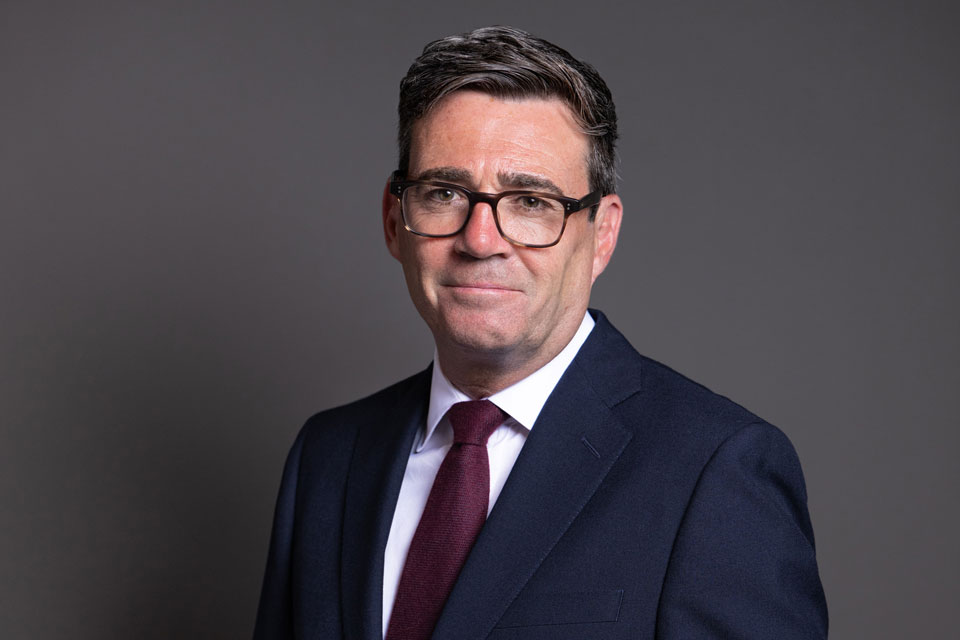
Prime Minister Andy Burnham delivered a speech in Scotland today.
It’s great to be with you. Thanks to the college, as Douglas says, for having us.
It’s good to be back in Scotland, to be here in Motherwell.
And I should say - I’m going to say this now, but I might regret it - the true north!
Please don’t tell anyone in Manchester that I said that.
You know I’ve created Number 10 North? Are you aware of that? Have you heard of that?
I know here you’ll probably call it Number 10 South.
And then you’ve got now Number 10 South South.
So you’re going to have to have your own way now of describing it.
But it is brilliant to be here.
I was in Scotland for the Opening Ceremony of the Commonwealth Games in the summer and, can I say, what a job Glasgow did in stepping forward to host it. Really grateful to them, did it brilliantly.
I’m actually here more than you might think. I sneak into Scotland without you knowing. I was here between Christmas and New Year last year for Hibs-Hearts and it has not escaped my notice that Motherwell are currently above the former in the SPL.
Although, well I think there are some Motherwell supporters here, surely. I hope there are.
I care about Scotland and I am coming today with a big offer and in search of common ground.
When I walked into Downing Street in July, I said I wanted to do politics differently. Place-first not party-first.
Honestly, I meant it. I meant it and I arrive here in that spirit because people in Scotland, in my view, deserve better from politicians and politics, as they do all over the UK, to be honest.
So that’s why I’m here. I’m here in that spirit because I want to show that politics can be better and we can work in a different way, place first, not party first.
And I want to say something so Scotland understands this.
I left Westminster in 2017 to become the first Mayor of Greater Manchester because I had come to see quite clearly how Westminster didn’t work for the North of England, North West of England as well.
My work on Hillsborough had brought me to the same conclusion that Scotland had reached many years before us.
And I felt the same frustrations as Scotland, Scottish ministers, in my ten years as the mayor, because often the way we were treated wasn’t right, it wasn’t good enough.
So I want everyone in Scotland to know that my reason in going back to Westminster is not to carry on with the same old Westminster and Whitehall ways and go back to that, I’m going back to change all of that. That’s why I’m Prime Minister.
When I say I want good growth in every postcode, that means every single postcode in Scotland as well.
And what that requires is giving more power to people and places everywhere to change more things for themselves.
One of the most important examples of this that I have seen came not from Manchester but from somewhere not so far from here.
In August 2023, with the help of the ground-breaking Scottish Violence Reduction Unit, I visited FARE-Scotland at Bannatyne House in Easterhouse with the Greater Manchester Violence Reduction Unit.
And we went because we’d heard all of the reports about what was happening, and the innovation that they were doing in Easterhouse.
Many of our communities had the same challenges - unfairly labelled and, you know, given a certain reputation - and that kind of hangs over.
But we had picked up on the stories that were coming out of things that were being done to turn people’s lives around.
So we went to see.
I had expected to spend two hours there talking about policing, drugs and violence.
Instead, we only talked about empowerment and opportunity.
The need to stop communities being labelled and defined by the negatives and instead to celebrate their positives and the assets that they’ve got.
It was an amazing time. I’ll never forget it.
And also we talked about how to create personal pathways, very personal pathways, for each young person, individually tailored for them, working with local employers.
And then to help those young people take those chances up to get them the right clothes so they didn’t feel out of place when they were going to those opportunities and those appointments, or those interviews, and have their travel covered as well.
It was something I’d never really heard explained in quite that way before.
It was true extra mile, bottom-up, person-centred support.
Rooted in local values.
Run by the local community and the people on the estate.
And it worked.
Well, why wouldn’t it work? It would work, wouldn’t it, if you run things like that. That’s how they should be done.
So I took everything I heard that day from Easterhouse and I took it back to Greater Manchester and I used it to pioneer what we called the Live Well model in Greater Manchester.
It was all about moving away from top-down, tick box systems that no one trusts and sometimes can make people feel worse about themselves, not better, when they’ve interacted with that system.
It was about moving away from the often patronising approach of public services so powerfully described by Darren McGarvey in his book Poverty Safari. And if you haven’t read it, I would recommend it to you.
And it pointed towards a new approach based on trusting local communities, and let them sort things out for themselves, because they know the solutions that they need.
And lo and behold, just as Easterhouse had done, we began to achieve more for people than we could have imagined before through Live Well.
So I carry all of that learning with me into my time as Prime Minister, and I am really clear about the changes I want to see.
When I walked up Downing Street and into No10, I was determined to push power out of it - and into the hands of local people. That’s what this country needs, in my view, all over it. In all of the regions, in all of the nations.
To rewire the state, rewire it so that it works right across the UK, and every postcode is empowered to do more for itself.
So I will do that because in the past we saw too many people, too many places written off, powerless to fight the effects of deindustrialisation.
And I don’t think I need to say that in this room today, with the history that there is on this site with regards to the effects of deindustrialisation.
I don’t want anyone ever to be in the position again that this community was in 30 or so years ago.
And it’s the reason I wanted to come to Motherwell today.
The story of this area and this town gets to the heart of why I believe we need to do things differently.
You know, it’s important to talk to Pamela today as the local MP to understand that history, but also to understand how those challenges are still there, and we know they’re very real challenges, and we want to be able to empower people here to be able to do more, to soften the effects of those things, find new solutions.
What you have here is a proud manufacturing past, and the apprentices who are with us today are obviously taking that tradition forward, and we’re proud of you, and we know you’ll go on to do great things.
But you’ve been let down. Certainly young people in all parts of the UK have been let down by political choices made far away from here.
By people often who have no clue, really, about what life is like here.
So that is basically the history.
You know, in the past, if you think about this area, if Britain was building something big the fair chance was the steel would have come from here.
You know, it was the heart of an industrial Britain.
And this college, I think I’m right in saying, is on the very site where Ravenscraig once stood.
And in my youth, if I go back to the 70s and 80s, you couldn’t not hear that name, Ravenscraig, on the news, such was its massive importance to the country.
When it closed, it wasn’t just a works that shut.
It was a whole community which saw the pillars underneath it just taken away, collapse beneath it.
And that was a decision taken hundreds of miles away by people, without any real consequences for what that would mean for people here.
Taken by people who would never have to live with those consequences and see those consequences every day.
And more than thirty years on, I know that work is still ongoing to fill the Ravenscraig site, such is the hole that it left.
And I know that story myself, as well.
Because I represented a former mining community, Leigh in the old Lancashire coalfield, and I was the MP there for sixteen years from the early 2000s, just after the pits had shut in the 1990s.
It broke my heart to see the old miners shuffling into my surgery every week carrying oxygen bottles still struggling to get compensation for the damage that was done to their lungs
It pained me to drive past the wasteland around Bickershaw Colliery, one of the last pits to close in Leigh.
Nobody asked Leigh what was going to come next either.
No one in Whitehall went to Leigh and said, “Here’s what we’re going to do with transition”. Just gone.
And this is the way the UK has been run in our lifetimes, and it’s what needs to change.
It took so much, this country, from Motherwell and its people in terms of the building of Britain.
And it took so much from Leigh in terms of the powering of Britain, and then just abandoned them when life moved on.
So I am here today to spell out how I plan to do things differently as Prime Minister in all parts of the UK.
Taking power out of the centre, and putting it into places like this, empowering people.
Because that to me is just as important in Scotland as it is anywhere else in the UK.
All of the nations that make up the UK, including Scotland, are too unequal internally.
Like in England, public transport in Scotland is way better in the capital of Scotland than it is in any other city or town in Scotland.
Or if you look at high streets.
If you go to Edinburgh today, you’ll see around one in twenty shops lying empty.
But if you go to Dundee, it’s more likely one in five.
Again, not an accident.
It’s what happens when too many of the good jobs go.
When the spending power reduces, and then obviously the high streets suffer and the shops go.
And people in Aberdeen are living through that now, and they’re very much on my mind, and I’ll have more to say about that in due course.
If you look at population in Scotland, there are places that haven’t grown like the rest of Scotland, where if you say in the West like Inverclyde, the working population has shrunk.
And why? It’s because it’s what happens when young people can’t see a future for themselves in those areas, and then they move away to find it.
And this one should really give us pause for thought: life expectancy.
It’s wonderful to see the emphasis being put in this college, if I could say this to the principal, on brain health.
Really asking every student to think about health.
I think that’s such a powerful message that you’re sending.
But the truth is we need to do that because the health inequalities are still far too wide.
A man in East Renfrewshire can live, as I understand, on average seven years longer than a man in Glasgow, even though there is only ten miles between the two places.
It’s the same elsewhere, in all parts of the country.
You can just go a few miles and you can see the housing change, you can see the community change, and of course you can see then the health of the people is not what it should be.
And when people live in a country like that, where it doesn’t feel fair place to place, that’s what then creates the divides that people see, and then it damages people’s trust, and they don’t feel the country is fair to all people and to all places.
Because when you’ve watched the works go, when you’ve watched the jobs go, the high street become empty, and one government after another tell you that things will get better, why should anybody believe any of us?
And it means we’ve got to change first. Politicians have to change.
Write a new script, do things very differently, because it’s not been working, what we’ve been doing.
We spend a lot of time focusing on the differences between Scotland and England.
But what is perhaps more striking is how similar the problems in places across Scotland and England.
The same cost-of-living pressures and lack of good jobs.
The same huge gaps between the regions.
The same decline sometimes seen on the high streets.
And the same sense that where you live still has too much bearing on your life as a whole.
And the issue was never the regions themselves.
They never lacked potential.
Ambition…
Talent…
Drive.
It’s just that the country, at a national level - UK level, Holyrood level - has not often shared the same ambitions of those places and empowered them to achieve those ambitions.
For decades, the centre sown in London has looked past too many places.
And hasn’t trusted people in those places to make their own decisions about their future.
And that centre has also refused to give up power when it’s been asked to do so. It’s kept hold of the power even when places across the country have been desperate for more ability to do more for themselves.
Twenty-seven years on, you led the way on devolution here in Scotland with the creation of the Scottish Parliament.
And that was absolutely right.
But devolution was never meant to stop there.
It was never supposed to stop at the doors of the Scottish Parliament.
Obviously, there’s huge progress to look back on.
Public control of water…
Public ownership of rail…
Free personal care…
And these are all Issues very close to my own heart, and I applaud them…
But they were always meant - as I understand it, because I was in Parliament, as Douglas said, at the time with him - always meant to be the start of something deeper.
The foundations of a nation where communities had more of a say in their own future…
And where the norm was always to push power out until it reached every person and every post code.
Instead, we’ve ended up with the situation where Scotland, the most devolved nation in the UK, is itself one of the most centralised nations in Europe.
And I don’t say that to score points.
Genuinely, I don’t.
I say that because I believe we need to be honest about that if we really want to get growth in every post code, if we really want to renew every part of the United Kingdom.
That’s why one of the first things I did as Prime Minister was start shifting that power out of Westminster.
And already we’re giving local leaders in England more power and control over transport…
More say over skills and investment…
More freedom to build an economy around the strengths of their communities.
We’re finally making the centre work for people…
Rather than asking them to work around us.
And this is what I mean by devolution by default, and deep devolution.
Not swapping power from one parliament to another…
But going deeper.
Putting power down into the regions…
Control back into the hands of the local people who know how to use it best.
And as our English regions see the benefits…
I want those same opportunities for Scotland and Scottish regions.
The chance to stop looking back what was once here…
And start looking forward to what’s coming next.
And that does mean something different for both governments, the UK government and the Scottish government.
This is the heart of what I wanted to say to you today.
It means working together in a different way and backing places in a different way across Scotland, and giving them the necessary investment to bring forward a new vision for the reindustrialisation of Scotland that these young people who are with us today can feel hopeful about.
It is great that the Scottish government has this week agreed to match the UK government’s £10 million to create two defence technical excellence colleges, and Douglas informed me of that news today.
So there will be one in the east and one in the west.
That’s an example, I think, of how it should be done.
The UK government and the Scottish government making something bigger than it might otherwise have been if one of them had done it alone.
And credit to Douglas and John Swinney for working together on that.
It means Scots trained for well-paid, skilled jobs in a defence sector that already supports 12,000 jobs here in Scotland
My government’s job is to do whatever we can to support more of those high ambitions in every part of Scotland.
It’s why we’re backing Scottish shipbuilding.
It’s why we’re working with the Scottish government to help secure new investment and new opportunities for the Grangemouth site. And we will keep working hard at that.
And it’s why we are committed to ensuring the next generation of energy jobs, created right here in Scotland.
Because I know how much these industries matter to people.
To workers.
To their families.
And to the communities they have built around them.
It’s also why I am working on a new deal for food and farming at the EU-UK Summit on the 20th of November.
I am working closely with our EU partners in relation to that. Why? Because it would have hugely beneficial impacts on the food industry and farming here in Scotland.
And it is why I want to see a change in public procurement across the UK and working with the devolved governments, the same there.
When I was Mayor of Greater Manchester, I put buses back under public control, and it meant I had the ability to choose where the buses we bought were built, and I chose Scotland.
I chose to back Scottish manufacturing.
I rejected the old Whitehall way of always going to find the cheapest contract anywhere in the world, because I recognised if you paid even a little more, it would still have circular benefits for British communities.
So I was determined that the buses on the roads of Greater Manchester today were built by Alexander Dennis in Falkirk.
And I did that because I knew it would sustain those communities. And Euan was there with me when we announced some of those contracts.
I want all public procurement in the UK to work like that, to follow the same approach and back a plan, a solid plan, to reindustrialise all of Britain.
But, from there, we have to allow our own regions to forge their own future, and that means Westminster and Holyrood learning to let go and make decisions about what comes next themselves.
The good news is Scotland’s regions already have so many strengths to build on.
In Dundee, you’ve got a world-leading video games industry.
Across the Highlands and the Islands, you’re building a new space industry, with new launch sites emerging.
In Edinburgh, a thriving fintech sector.
The list goes on.
Imagine what more places could achieve if they had greater control and investment to help those businesses grow.
If the people who understood those industries best had more say over where the money went, and which opportunities they went after, they would be building more stronger technical education paths, education paths into their emerging sectors.
We’ve already seen glimpses of what that can look like.
An approach that puts local businesses, universities and councils in the driving seat has seen companies like Chemify turn groundbreaking research into real manufacturing jobs in Glasgow.
And that’s the sort of thing I want to see so much more of.
It’s why we’re putting a billion pounds into research and innovation across the UK in the coming years.
But I don’t want all the decisions about where that money goes being made in Whitehall.
We’re already giving English mayors more control over funding for local innovation.
And I want to explore now how Scotland’s regions can have the same powers to decide where more of that research and development investment goes.
Because the people building these industries, they know where those industries can go in the future.
Our job isn’t to stand in their way…
It’s to give them what they need to go after those opportunities.
And there’s one more thing.
Because none of this means very much if the people growing up in these communities don’t get the chance to take up the opportunities that come out of it.
We can announce all the investment we like and all of the big numbers.
We can build factories…
We can win contracts…
We can create new businesses.
But if a young person down the road growing up here can’t get the skills or support they need to work there…
Then we haven’t got it right.
And right now, too many young people are missing out.
I mean, none of us feel comfortable about these statistics, and it’s the same in England, I’m not pointing the finger at Scotland.
But the fact is around one in six young people here are not in education, employment or training.
It just isn’t right, is it? It isn’t good enough.
All of those young people experiencing that feeling of less hope and not having a sense of direction for the future.
I’ve been clear that care for people is at the heart of everything that I’m about and what my government will do.
And I won’t have a country where we get comfortable with the idea of kids in their 20s just being there on benefits.
I won’t. I never will accept that some are just written off, given the feeling that they don’t matter or they’re not seen.
I don’t believe the answer is another scheme designed in the centre - another top-down scheme - and then kind of imposed on every community in the way that we’ve done it in the past.
It won’t work again. We’ve heard it before.
The review led by Alan Milburn is challenging us to look at this very differently.
To build a system based on the Easterhouse principle of names not numbers.
Build it from the bottom up.
Let communities build it. They know best.
And this is what I’m here to say. I think the time has come for deeper devolution in Scotland to empower all of the proud places across this wonderful nation, every single bit of it.
More power to do more, and that unlocks a feeling of positivity that you can do something to change the place where you live.
That’s what I want to see. More power to give people the support they need to access opportunities as they become available in new industries.
And, crucially, treat them as an individual.
I come back to that phrase, names not numbers.
That’s what you can do when you work from the bottom up, as they did in Easterhouse.
You can just think about the person in front of you, not sometimes the “computer says no” approach where you just give them bad news.
Come at it a different way, see what they’ve got, and then help them unlock all of that potential.
Don’t see them as a problem to be managed via a programme designed and implemented from Westminster or Holyrood.
Because the barriers a young person faces in Glasgow, they won’t necessarily be the same as someone growing up in the Highlands.
And the opportunities in Dundee won’t be the same as those in Lanarkshire. That’s just a fact.
I want to work with the Scottish government and Scottish local government to join up colleges, employers, employment support and local services.
And just like Scotland did in Easterhouse.
And just like we did in Greater Manchester, let’s create a new way of supporting people.
That’s the vision everybody. I hope it resonates: a revitalised Scotland in a reindustrialised UK, where every region plays their part, and there are new paths for people in every post code across the UK.
I want all areas of Scotland to be part of that and to feel the possibility that they can be part of that, to play their part.
And I open out a hand to the Scottish government, perhaps not in a way that people in my job have come and done in the past, but I do.
Because I am long in my political career now, and I know enough now to know that tribal politics and point-scoring in the end doesn’t get you anywhere
Politicians like to do it, but the public can’t bear it because it just doesn’t work.
Problem-solving, not point-scoring is what I said when I walked up Downing Street and I mean it, and I’m going to stick to it. And you can all hold me to account on it.
I know progress has been made here over the last decade with the City Region Deals.
But it is time to think about what comes next.
And how we build on them for the next generation.
We need to look at the resources and decision-making powers that sit at the regional level in Scotland so that no Scottish city regions are left behind.
And I know the Scottish government has also announced a long-term programme for local government reform.
But, if you ask me, we’ve got to move faster and we’ve got to do more.
Growth won’t wait.
And if we don’t move now, Scotland could lose out.
There is a risk that some of the towns and the cities become underpowered when some of the towns and cities of the North of England are going the other way and starting to power up, and I don’t want to see that as Prime Minister.
I want everywhere to do well. And I think everywhere can do well.
I do want good growth in every postcode here and the rest of the UK.
And I want to work with the First Minister to deliver it.
Because, the fact is we won’t agree on everything and we’re not going to and we shouldn’t try because there are some things we will disagree on.
But that does not mean just because you can’t agree on everything it doesn’t mean you can’t agree on anything.
We can agree on some things, and I know that because I’ve worked with John over a long period of time as well.
In my mind, the real question is not whether we should try and work together…
The real question is why on earth we wouldn’t we?
It would only be party politics that would stop that, and that’s not a good enough reason not to try and work together.
So today I want to make a serious and genuine offer to the Scottish Government.
I want to move on from the old politics of conflict…
To bring people together….
Across governments and in Scotland…
Alongside Number 10 North….
Or Number 10 South to you…
And in the immediate months ahead, I want us to design a new model, together, of regional economic empowerment across all of Scotland.
One that puts control where it should be, in the hands of local people.
And if it’s going to really mean something, it has to be thorough.
At the UK-level, we are looking at how we can devolve innovation, enterprise and employability funding so that that can be used to be matched to the strengths of Scotland’s people and places to create new industries and jobs.
And let me just be really specific about this.
It goes back to what I said about that book, Poverty Safari.
Because I read that and it had a big impact on me.
You know, it makes people feel really remote, doesn’t it, from the powers that be and those making decisions?
So I’m going to be specific and make an offer today.
An offer of DWP devolution.
I want to offer Scotland a model of localised employment support, similar to the one in England but obviously shaped by Holyrood and one that’s right for Scotland, not repeating that.
Because that’s a classic example of where the UK government should work with the Scottish government.
If you want the best employment support, not a tick-box system, then it has to go deep. It has to go right down. In other words, it has to be based on the Easterhouse principle. Has to be.
Names not numbers. If it’s not based on that, it won’t work. It will just be repeating the same system in a different way.
But I want to give Scotland the power to take the Easterhouse model nationwide here
Not a project on one estate, but the way we support everybody, everywhere.
And we should absolutely explore how to give Scotland’s regions the ability to develop the skills, the transport systems and investment, the infrastructure, the housing, everything they need to make sure the areas here are set up to deliver their full potential.
So in a couple of weeks, the National Economic Council will meet with the First Ministers of Scotland and Wales, and the First Minister and Deputy First Minister of Northern Ireland, and we will do that for the first time since I became Prime Minister to put that offer on the table and to see if we can work out a plan together.
I think that feels different. I hope you sense that too as you hear me lay it out.
And my message to John is simple:
I want to push economic power out into the regions of Scotland.
Do you? Do you?
Because, if you do, let’s agree on it. Let’s agree a new process, working with Douglas and working with John’s team. Let’s agree on a new proposal that’s right for Scotland, and we work together on it.
Let’s have both of Scotland’s governments coming together with a joint ambition to push power out from the centre - from Westminster and Holyrood - and put it into the hands of local people.
And together, let’s reindustrialise Scotland.
Because I absolutely know that it can be done.
And I’ll finish on this point, you’ll be glad to hear. I’ve had a lot to say, and I wanted to say it directly so you understood fully where I am coming from.
Here’s the thing, how much time have we wasted - and I’m thinking about my visits as a politician to Scotland - how much time have we wasted just debating what differentiates us, rather than saying, right, what can we agree on and let’s talk about that, rather than talking about the other stuff.
And I think the time has come for that.
The country is not in a position to carry on putting politics before places and politics before people.
It’s not in a position. We can all see and feel that.
We need to build our prosperity everywhere.
We need to get the growth going everywhere.
And that’s the thing. If we get this right in this moment, we will all spend more time in the years ahead talking about the exciting things that are happening in all of the different places in Scotland, and less about politics and political dramas.
And after all, isn’t that the best thing of all that politicians could do for the people, to stop you having to worry about politics and all of us talking about how we build a better future together?
So thank you for listening, everybody. Thank you for letting me speak to you today. I am really taken by the fact that so many people are here, so many people are listening.
Is there a feeling that we make this a moment of change? Is that what people want?
And do you think you speak for people around Scotland? Does everyone want a moment of change? The two governments working together?
Well, let’s do it then.